Fostering South West: Fostering campaign
Opening homes
& changing lives.
Opening homes
& changing lives.

Fostering South West: Fostering campaign
Opening homes
& changing lives.
The situation
Fostering South West is a partnership between the 15 local councils from across the South West, and their mission is to welcome people into foster care and improve experiences for carers and the children they nurture.
The region was facing a significant carer shortage, with 7,000 children in care but only 1,860 approved foster homes. Demand was rising but approved foster homes were not. This lack of foster homes meant some children were being placed over 20 miles away from homes, friends and local environments during a critical and emotional time.
The client came to us with a clear goal: increase enquiries and widen the audience beyond the "typical" foster carer profile. We needed to overcome misconceptions about who couldn't foster (e.g. LGBTQIA+ individuals, ethnic minorities, single or younger people), and a lack of understanding of foster care responsibilities.
We wanted to make fostering feel possible, local, human. Less of a heroic leap and more as something built from everyday care.
Client
Fostering South West
Sector
Recruitment advertising
Services
Creative Consultation
Art Direction
Graphic Design
Awards
RAD Winner
RMA Winner
IHR Winner & Silver
The situation
Fostering South West is a partnership between the 15 local councils from across the South West, and their mission is to welcome people into foster care and improve experiences for carers and the children they nurture.
The region was facing a significant carer shortage, with 7,000 children in care but only 1,860 approved foster homes. Demand was rising but approved foster homes were not. This lack of foster homes meant some children were being placed over 20 miles away from homes, friends and local environments during a critical and emotional time.
The client came to us with a clear goal: increase enquiries and widen the audience beyond the "typical" foster carer profile. We needed to overcome misconceptions about who couldn't foster (e.g. LGBTQIA+ individuals, ethnic minorities, single or younger people), and a lack of understanding of foster care responsibilities.
We wanted to make fostering feel possible, local, human. Less of a heroic leap and more as something built from everyday care.
Client
Fostering South West
Sector
Recruitment advertising
Services
Creative Consultation
Art Direction
Graphic Design
Awards
RAD Winner
RMA Winner
IHR Winner & Silver
The situation
Fostering South West is a partnership between the 15 local councils from across the South West, and their mission is to welcome people into foster care and improve experiences for carers and the children they nurture.
The region was facing a significant carer shortage, with 7,000 children in care but only 1,860 approved foster homes. Demand was rising but approved foster homes were not. This lack of foster homes meant some children were being placed over 20 miles away from homes, friends and local environments during a critical and emotional time.
The client came to us with a clear goal: increase enquiries and widen the audience beyond the "typical" foster carer profile. We needed to overcome misconceptions about who couldn't foster (e.g. LGBTQIA+ individuals, ethnic minorities, single or younger people), and a lack of understanding of foster care responsibilities.
We wanted to make fostering feel possible, local, human. Less of a heroic leap and more as something built from everyday care.
Client
Fostering South West
Sector
Recruitment advertising
Services
Creative Consultation
Art Direction
Graphic Design
Awards
RAD Winner
RMA Winner
IHR Winner & Silver
The solution
We dug into regional research, tackled the real barriers behind the shortage, and stress-tested the usual recruitment messaging.
What we found was not a lack of goodwill, but a lack of self-belief.
People assumed they wouldn't qualify, or that fostering required specialist skills they didn't have. Others couldn't picture the day-to-day reality, so the idea never got past a distant “maybe.”
We built the campaign around a simple truth: fostering is made of small moments. Not grand gestures.
This helped us to create the campaign strapline "Open your home. Change a life.", because it did two things at once. It made the ask clear, and it gave the audience a reason to see themselves in it.
The solution
We dug into regional research, tackled the real barriers behind the shortage, and stress-tested the usual recruitment messaging.
What we found was not a lack of goodwill, but a lack of self-belief.
People assumed they wouldn't qualify, or that fostering required specialist skills they didn't have. Others couldn't picture the day-to-day reality, so the idea never got past a distant “maybe.”
We built the campaign around a simple truth: fostering is made of small moments. Not grand gestures.
This helped us to create the campaign strapline "Open your home. Change a life.", because it did two things at once. It made the ask clear, and it gave the audience a reason to see themselves in it.
The solution
We dug into regional research, tackled the real barriers behind the shortage, and stress-tested the usual recruitment messaging.
What we found was not a lack of goodwill, but a lack of self-belief.
People assumed they wouldn't qualify, or that fostering required specialist skills they didn't have. Others couldn't picture the day-to-day reality, so the idea never got past a distant “maybe.”
We built the campaign around a simple truth: fostering is made of small moments. Not grand gestures.
This helped us to create the campaign strapline "Open your home. Change a life.", because it did two things at once. It made the ask clear, and it gave the audience a reason to see themselves in it.


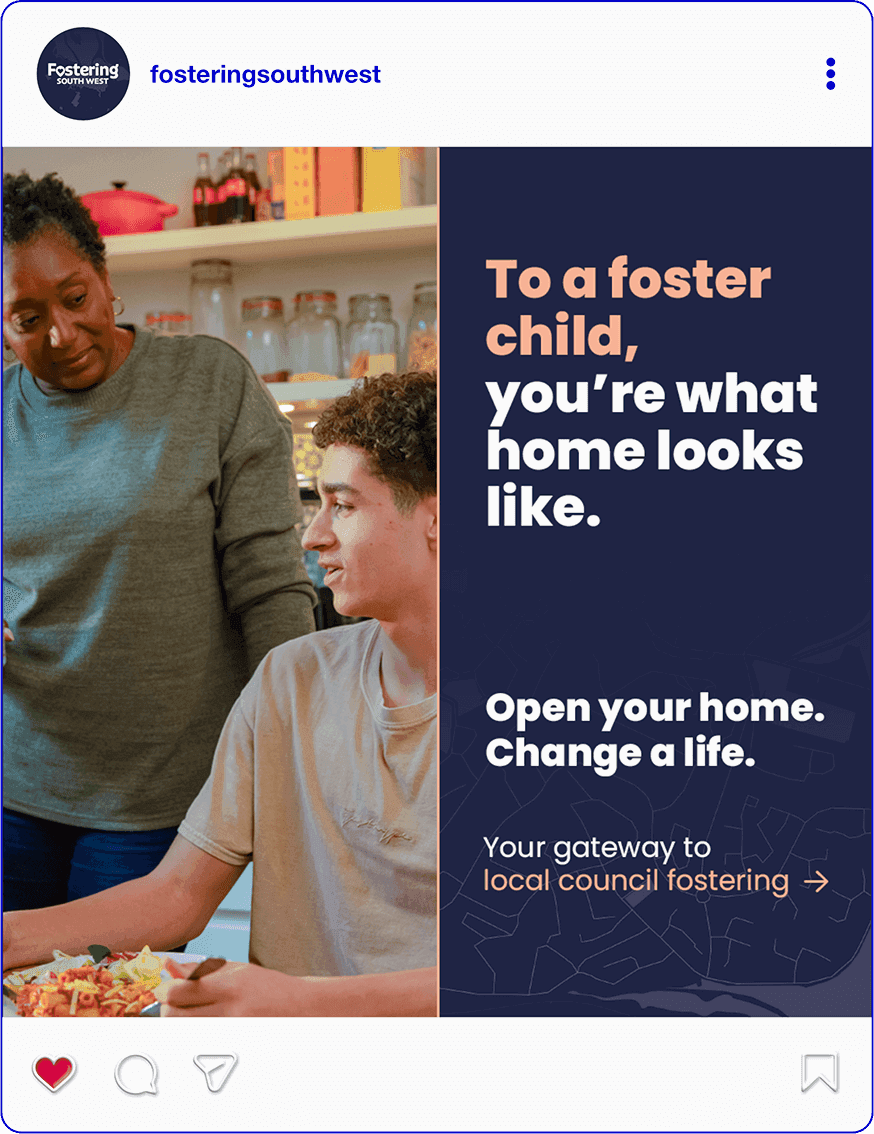


To reach the right people, we focused on audiences that were most likely to care but least likely to apply: empty nesters, professional carers, and inclusivity champions. We then crafted messaging built to remove the "I couldn't do that" doubt.
Execution followed the same principle. Working with Fostering South West's existing brand, we refreshed the messaging and imagery, using targeted social posts that spoke directly to these audiences and reflected them in the visuals.
To reach the right people, we focused on audiences that were most likely to care but least likely to apply: empty nesters, professional carers, and inclusivity champions. We then crafted messaging built to remove the "I couldn't do that" doubt.
Execution followed the same principle. Working with Fostering South West's existing brand, we refreshed the messaging and imagery, using targeted social posts that spoke directly to these audiences and reflected them in the visuals.

An out-of-home campaign on buses across the region helped to build a local presence.
An out-of-home campaign on buses across the region helped to build a local presence.
Local radio ads built on the theme further by touching on some of the realities and rewards of fostering.
Local radio ads built on the theme further by touching on some of the realities and rewards of fostering.

Fostering South West: Radio Ad
Campaign films
To address our audience's main misconception – that they lacked the ability to care for a foster child, we created a series of films.
Each film was built on the core idea that it's the everyday moments, added up over time, that make a loving home. They demystified fostering and showed the impact that can be made with small acts of care, while evoking an emotional response that would move our audience into action.
Real foster carers were chosen who represented the different fostering types. An intimate, direct-to-camera style immediately immersed our audience into the stories. They created the sense of a private conversation rather than an ad campaign. Honest, warm, and not overly polished.
Snippets from each film were shared on TikTok, which drew in a younger audience, while targeted TV and Meta advertising invited the audience to watch the full films.
Campaign films
To address our audience's main misconception – that they lacked the ability to care for a foster child, we created a series of films.
Each film was built on the core idea that it's the everyday moments, added up over time, that make a loving home. They demystified fostering and showed the impact that can be made with small acts of care, while evoking an emotional response that would move our audience into action.
Real foster carers were chosen who represented the different fostering types. An intimate, direct-to-camera style immediately immersed our audience into the stories. They created the sense of a private conversation rather than an ad campaign. Honest, warm, and not overly polished.
Snippets from each film were shared on TikTok, which drew in a younger audience, while targeted TV and Meta advertising invited the audience to watch the full films.
Campaign films
To address our audience's main misconception – that they lacked the ability to care for a foster child, we created a series of films.
Each film was built on the core idea that it's the everyday moments, added up over time, that make a loving home. They demystified fostering and showed the impact that can be made with small acts of care, while evoking an emotional response that would move our audience into action.
Real foster carers were chosen who represented the different fostering types. An intimate, direct-to-camera style immediately immersed our audience into the stories. They created the sense of a private conversation rather than an ad campaign. Honest, warm, and not overly polished.
Snippets from each film were shared on TikTok, which drew in a younger audience, while targeted TV and Meta advertising invited the audience to watch the full films.
The results
The campaign ran for five months and delivered a fundamental shift in both volume and quality of response.
Enquiries rose to 2,088 from 833 in the previous five months, There was an increase of 150% in actionable enquiries. The average age of applicants dropped from 58 to 48. And there was a 100% increase in actionable enquiries from underrepresented groups, including LGBTQIA+ and ethnic minority audiences.
Digital impressions surged to 17 million and over 380,000 clicks. Active users on the Fostering South West website saw a 2,000% increase from 18,000 to 409,000 during the campaign. And finally, website views increased by over 1,600% from 26,900 to over 485,500.
The results
The campaign ran for five months and delivered a fundamental shift in both volume and quality of response.
Enquiries rose to 2,088 from 833 in the previous five months, There was an increase of 150% in actionable enquiries. The average age of applicants dropped from 58 to 48. And there was a 100% increase in actionable enquiries from underrepresented groups, including LGBTQIA+ and ethnic minority audiences.
Digital impressions surged to 17 million and over 380,000 clicks. Active users on the Fostering South West website saw a 2,000% increase from 18,000 to 409,000 during the campaign. And finally, website views increased by over 1,600% from 26,900 to over 485,500.
Enquiries
Actionable enquiries
Average age reduced
Clicks
Active users
Website views
Beyond the numbers, the work proved that inclusive, emotionally honest story telling can shift behaviour in an audience that was stuck in hesitation. The campaign was recognised at the RMA Awards, the RAD Awards, and the IHR Awards.
Beyond the numbers, the work proved that inclusive, emotionally honest story telling can shift behaviour in an audience that was stuck in hesitation. The campaign was recognised at the RMA Awards, the RAD Awards, and the IHR Awards.
Winner
Skills Shortage Resourcing
Winner
Integrated Campaign
Best Recruitment
Marketing Campaign
Silver
Best Video
But more important than any award, this campaign mattered. It helped more people take the step from "I'm not sure" to "maybe I can", and that meant that more children could stay closer to home and give them what every child deserves, safety, consistency and care.
But more important than any award, this campaign mattered. It helped more people take the step from "I'm not sure" to "maybe I can", and that meant that more children could stay closer to home and give them what every child deserves, safety, consistency and care.
Beyond the numbers, the work proved that inclusive, emotionally honest story telling can shift behaviour in an audience that was stuck in hesitation. The campaign was recognised at the RMA Awards, the RAD Awards, and the IHR Awards.
Winner
Skills Shortage Resourcing
Winner
Integrated Campaign
Best Recruitment
Marketing Campaign
Silver
Best Video
But more important than any award, this campaign mattered. It helped more people take the step from "I'm not sure" to "maybe I can", and that meant that more children could stay closer to home and give them what every child deserves, safety, consistency and care.